Finding the China Best Magnetic Smartwatch Charger Supplier? The answer depends on your watch model, target market, and quality expectations. A reliable supplier should provide stable magnetic alignment, consistent charging output, strong cable strain relief, and documented production controls. These details matter when a charger must connect cleanly beside a watch case, even after hundreds of daily uses.
Jeff Ravencraft, President and Chief Operating Officer of the USB Implementers Forum, has described USB Type-C as “the connector of the future.” His observation is relevant because many modern Magnetic Smartwatch Charger designs use USB-C input for broader compatibility. However, the connector alone does not prove product quality. Buyers should request charging tests, temperature records, material specifications, and samples from different production batches.
Look closely.
A practical audit should examine magnet strength, coil positioning, charging efficiency, cable flexibility, and protection against overheating. Ask whether the supplier owns its factory or relies on outside assembly. Confirm how it handles failed samples, firmware changes, packaging defects, and replacement requests. Certifications should be checked against the destination market, not copied from another model.
No supplier is the best choice for every project. A low factory price may hide higher failure rates, slower communication, or inconsistent components. Even attractive samples can disappoint during mass production. That is an uncomfortable reality. Independent inspection and repeat testing remain worthwhile.
This guide compares Chinese suppliers through engineering capability, manufacturing experience, communication reliability, customization support, and long-term service. The goal is not to promote the cheapest option. It is to identify a dependable partner for a Magnetic Smartwatch Charger that performs safely on real desks, in real homes, and through repeated daily charging.
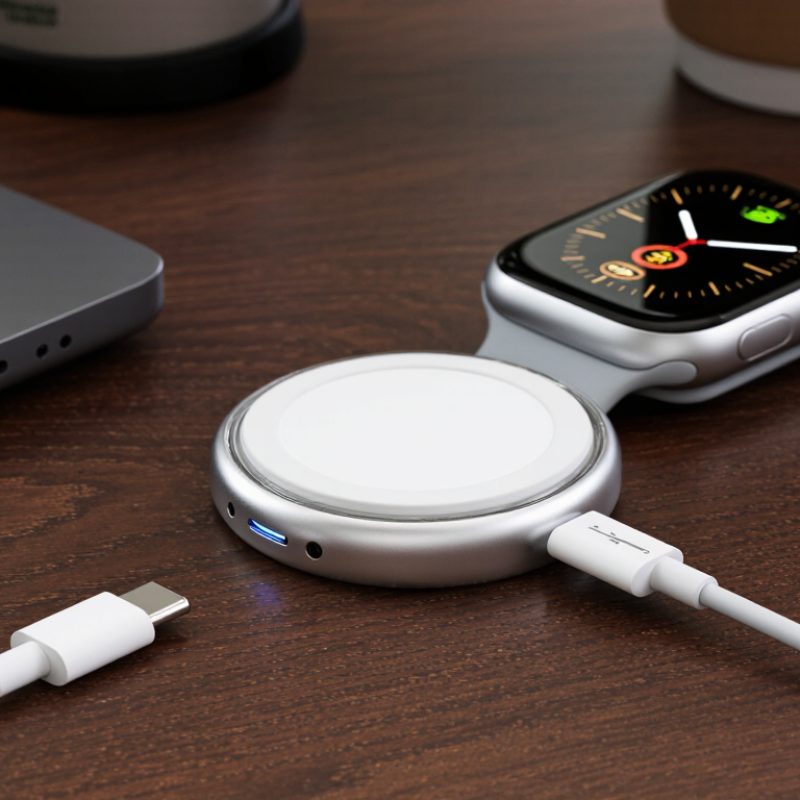
China’s smartwatch charger market is shaped by compact designs, low heat, and predictable 5W power profiles. Industry shipment data from IDC’s Worldwide Quarterly Wearable Device Tracker shows continued global growth in smartwatches and wrist-worn devices. This growth supports demand for standardized, low-power charging accessories.
A common profile is 5V at 1A, producing a maximum rated output of 5W. Some chargers accept USB-C input, while others still use USB-A cables. The magnetic charging head usually connects through two or four pogo pins. These contacts carry power, but they do not automatically support universal wireless charging. Qi compatibility should be verified separately. The USB Implementers Forum also distinguishes basic USB power delivery from higher-power USB Power Delivery systems. A 5W charger normally needs neither advanced negotiation nor high-current output.
Compliance needs careful checking. GB 4943.1-2022 addresses safety requirements for audio, video, information, and communication technology equipment in China. IEC 62368-1 is also widely referenced in international product evaluation. Testing should cover no-load voltage, temperature rise, short-circuit protection, magnetic alignment, and cable resistance. A 5W label is not a guarantee. Bench measurements can reveal unstable current or excessive heat near the charging contacts. I would also question whether every supplier reports efficiency under realistic conditions, because many specifications remain idealized. The small details matter.
Stable alignment matters more than magnet strength alone. The connector should guide the watch gently, without scraping its case. Test it after a light desk movement. A loose connection suggests weak mechanical control.
Pogo pins maintain electrical contact during charging. Check their travel, spring force, plating, and contact resistance. Tiny variations can interrupt power. They matter.
Contacts need protection from sweat, dust, and repeated insertion. A recessed design can reduce accidental short circuits. Cleaning tests should include fine particles and metal debris. Magnets may attract nearby particles.
Evaluate insulation, creepage, clearance, accessible energy, and abnormal operation. Temperature tests should include blocked ventilation and continuous charging. Cable entry points need strain-relief testing. Normal coolness proves little.
Compliance supports a hazard-based safety review. It does not replace careful engineering records. Each test result should connect to a specific design control. Fault conditions deserve attention.
Review the ISO 9001 certificate, issuing body, validity dates, and production scope. Then check incoming materials, assembly, testing, and packing procedures. A certificate alone proves little. Ask for recent records.
Define sample size, acceptable defects, critical faults, and records before shipment. AQL 1.5 can provide a practical inspection benchmark. Test magnetic connection, charging stability, temperature, cable flexibility, and plug cycles. Link reports to batch numbers.
No. Sampling cannot reveal every defect. Compare units after repeated use, not only after the first connection. Check approved cable length, labels, packaging, and charging behavior. The first sample may mislead.
Ask how failed units are isolated, recorded, and corrected. Request corrective-action evidence when samples fail. Keep written acceptance criteria. Memory is unreliable.
Strong magnets can hide weak mechanical alignment. A watch may attach firmly but still charge inconsistently. Test movement, dirt exposure, repeated connections, and fault temperatures. Strong is not always stable.
China’s smartwatch charger market offers a wide range of 5W charging solutions, making it important to evaluate suppliers carefully. When selecting a Magnetic Smartwatch Charger manufacturer, buyers should compare minimum order quantities, production lead times, communication quality, and the results of factory audits based on orders of around 1,000 units. Product design should also be reviewed, including magnetic alignment accuracy, pogo pin durability, charging stability, and compliance with IEC 62368-1 safety requirements.
A reliable supplier should support USB-C input, RoHS-compliant materials, and appropriate USB-IF certification checks where applicable. Factory verification is equally essential: ISO 9001 systems, AQL 1.5 inspection procedures, and sample testing can help confirm consistent quality before mass production. By combining technical evaluation, documentation review, and practical testing, buyers can reduce quality risks and identify a dependable Chinese supplier for safe, compatible, and efficient Magnetic Smartwatch Charger products.

Dispatched from our UK warehouse with tracked shipping.
Every smartwatch and audio product is covered as standard.
One companion app across the whole product ecosystem.
Pairing, firmware and accessory help from our support team.
