Choosing a reliable Fast Charging Watch Cable manufacturer takes more than comparing product photos or quoted prices. Buyers need to examine charging performance, connector fit, material quality, and consistency between samples and bulk orders. A cable may look simple, yet small differences in pin alignment or insulation can affect everyday use.
This guide introduces ten China-based manufacturers for buyers evaluating sourcing options. It considers practical factors such as product range, customization support, production capacity, quality-control procedures, and communication. These details can help importers, brand owners, and distributors prepare more focused supplier discussions. Ask for clear specifications, sample units, and relevant test documentation before making a commitment. Confirm compatibility with the exact watch models you intend to serve; “universal” can mean different things to different suppliers.
Details matter. A useful comparison also looks at minimum order quantities, packaging choices, quoted lead times, and after-sales responsiveness. Company profiles and capabilities can change, so treat this list as a starting point rather than a final endorsement. No directory is perfect. Verify current information directly, and compare claims against samples and written specifications. A low price alone tells little about long-term reliability. Careful checks take time, but they can prevent costly misunderstandings once production begins.
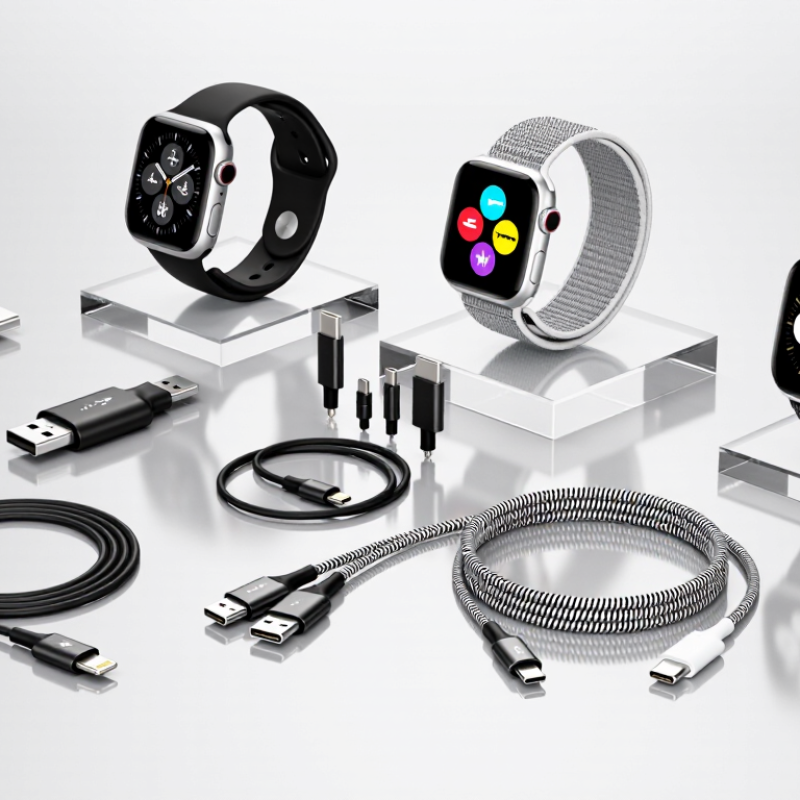
A fast-charging watch cable looks simple, but its design must manage alignment, power, and heat in a compact space. The charging puck should sit flat against the watch back, while magnets help keep it in position. Small shifts matter. A loose fit can interrupt charging when the cable rests near a bed edge or desk corner. Flexible insulation also helps reduce strain where the cable meets the connector.
Inside the cable, conductors and control components deliver power within the watch’s supported limits. Fast charging is not simply a matter of using more current; the watch, adapter, and cable must work together. A well-designed cable should help maintain stable output and limit excess heat. During evaluation, check connector firmness, cable flexibility, and temperature after a full charging session. These details tell you more than a glossy housing. Still, one short test cannot reveal every weakness.
Manufacturers should clearly document compatible models, charging conditions, and inspection procedures. Clear labeling helps users avoid mismatched adapters. The puck surface should resist scratches, and the cable entry needs reinforcement against repeated bending. I would also check for consistent charging across several placements, not just one perfect alignment. Not every design gets this right. A cable can feel premium and still charge slowly when its fit is slightly off.
China’s watch-cable manufacturing industry serves a market where compact size and dependable charging matter. Manufacturers produce cables with magnetic charging heads, molded housings, and USB connectors. Some suppliers also offer custom lengths, cable colors, and packaging. Details matter.
Production combines component sourcing, molding, assembly, and electrical testing. A cable may look simple, yet its charging contacts must align closely with the watch. Small shifts can cause intermittent charging or poor magnetic attachment. Materials also affect flexibility and wear: a stiff cable can strain its connector during daily use.
Factories may support prototype runs and larger orders, but capabilities vary. Buyers should check connector compatibility, charging performance, cable length, and test procedures before choosing a supplier. Ask for samples and inspect fit, finish, and charging stability across repeated use. Not always. A polished sample alone cannot prove consistent production quality. Clear specifications and batch inspection help reduce surprises, especially when requirements change between development and mass production.
Annual change in selected indicators for China’s electronic information manufacturing industry, 2023
Industry-wide figures provide context for China’s watch-cable manufacturing environment; they are not watch-cable-specific statistics. Source: China’s Ministry of Industry and Information Technology (MIIT), 2023.
When comparing watch cable manufacturers in China, evaluate proof, not polished catalog photos. Ask whether charging speed has been validated with the exact watch models and adapters you plan to sell. A cable may fit physically yet charge slowly or fail to align with magnetic contacts. Request test records covering output stability, connector temperature, bend endurance, and repeated attachment. Small details matter. Check whether the supplier inspects incoming materials and finished cables before packing.
Tips: Request three to five samples from one batch. Compare magnetic alignment, cable flexibility, and charging time using the same watch and power source.
Review quality documentation and ask how defects are recorded, traced, and corrected. Confirm minimum order quantities, lead times, packaging options, and production capacity during seasonal demand. A technically capable factory may still be a poor fit if updates arrive late or specifications drift between samples and bulk production. For private-label projects, approve a specification sheet covering cable length, materials, connector details, and acceptance limits. Do not rely on one successful sample. Repeat checks after any design or material change.
Profiles of China’s top fast-charging watch-cable manufacturers should separate proven capability from attractive catalog claims. Counterpoint Research’s Global Smartwatch Model Tracker reported that smartwatch shipments fell 1% worldwide in 2023. This market figure is not cable demand, but it reflects a fragmented device base. Compatibility is the hard part.
Compare each manufacturer’s charging-contact design, cable resistance, strain relief, and temperature control. Ask for batch-level test records, not just a single sample. A useful profile also covers connector tooling, assembly capacity, customization lead times, and defect handling. Some suppliers excel at rapid sampling; others provide steadier high-volume output. Those strengths are not interchangeable. A polished factory tour proves little.
Review evidence for repeated charging cycles, plug retention, bending durability, and stable output under load. Confirm which watch models and charging protocols were tested, since “fast charging” is not universal. Keep claims tied to dated reports and production lots. One caveat: public profiles often lack comparable failure-rate data. Buyers should request it, then verify a random production batch before approval.
When comparing China’s top 10 fast charging watch cable manufacturers, look beyond advertised charging speed. Ask how each factory verifies connector fit, temperature rise, and stable power delivery across repeated charging cycles. A reliable process uses defined test limits and records results by production batch. Small details matter.
Quality control should cover incoming materials, assembly, and finished cables. Inspect the charging puck for alignment and secure contact, then test cable flexibility near the connector, where wear often begins. Sample testing is useful, but it cannot reveal every defect. Request clear explanations of test methods, traceability, and any applicable safety or electromagnetic compatibility documentation. Claims without supporting records deserve a closer look.
Market demand is shifting toward compact designs, durable cable jackets, and compatibility with newer watch models. Manufacturers may also face pressure to shorten lead times without weakening inspection. That trade-off is not always handled well. A polished factory report can still miss problems that appear after months of bending or daily use. Buyers should compare independent test evidence, production controls, and after-sales defect data, rather than choosing on price alone.
Industry benchmark covering ten relevant manufacturing and sourcing dimensions. It is not a ranked list of companies; no company or brand data is included.
| No. | Manufacturing Dimension | Relevant Standard or Reference | Practical Quality-Control Check | Market Trend |
|---|---|---|---|---|
| 1 | Quality management system | ISO 9001:2015, where implemented and certified | Review document control, corrective-action records, traceability, and internal-audit procedures. | Buyers increasingly request auditable process records and supplier-level quality metrics. |
| 2 | Electrical continuity and polarity | Product-specific electrical specifications; verify applicable USB requirements for the upstream connector | Use 100% continuity and polarity testing to detect open circuits, shorts, and wiring errors. | Stable charging performance and fewer intermittent-contact failures remain key purchase criteria. |
| 3 | Connector and cable durability | Customer-defined test methods and acceptance limits | Conduct bend, pull, and connector-retention tests using documented fixtures and cycle counts. | Reinforced strain relief and flexible cable jackets are common design responses to daily-use wear. |
| 4 | Electrical safety of powered components | IEC 62368-1 may apply to relevant audio/video and ICT equipment; confirm product scope and destination-market rules | Assess insulation, accessible conductive parts, abnormal operation, and temperature where applicable. | Compliance documentation is increasingly important for complete charging systems and bundled power products. |
| 5 | Magnetic charging interface | Device-specific interface drawings and performance requirements | Check contact alignment, magnetic retention, charging stability, and surface condition against approved samples. | Compatibility across device models remains a major constraint because many watch interfaces are proprietary. |
| 6 | Restricted substances | EU RoHS Directive 2011/65/EU, as amended; REACH obligations where applicable | Maintain material declarations and supplier records; use laboratory testing when required by risk or regulation. | Destination-market chemical compliance and material traceability are standard sourcing considerations. |
| 7 | Ingress-protection claims | IEC 60529, when an IP rating is claimed for the relevant product or enclosure | Test the defined finished assembly; do not infer water resistance from cable materials alone. | Demand for sweat- and splash-resilient designs is rising, while substantiated claims remain essential. |
| 8 | Lot inspection and sampling | ISO 2859-1 provides attribute-sampling plans; sampling levels and acceptance limits must be agreed by the buyer and supplier | Define inspection criteria for appearance, dimensions, labeling, function, and packaging before production. | Risk-based incoming and pre-shipment inspections help buyers manage quality across contract manufacturing. |
| 9 | USB input and power claims | USB-IF specifications and certification programs where applicable; USB Power Delivery applies only to products designed to support it | Verify connector configuration, stated input limits, and compatibility claims against the actual product design. | USB-C input is increasingly requested, but a USB-C connector alone does not establish USB PD support or watch charging speed. |
| 10 | Environmental management and packaging | ISO 14001:2015, where implemented and certified; packaging obligations vary by destination market | Review environmental procedures, packaging specifications, and evidence supporting material claims. | Reduced packaging, recyclable materials, and supply-chain environmental reporting are gaining attention. |
The watch, adapter, and cable must work together within the watch’s supported limits. More current alone does not guarantee faster charging.
The charging puck should sit flat against the watch’s back. Small shifts can interrupt charging, especially near a desk edge.
Check its temperature after a full charging session. One test helps, but it cannot reveal every weakness.
Try three to five samples from one batch. Compare fit, charging time, flexibility, and magnetic attachment using the same watch and power source.
Flexible insulation can reduce strain near the connector. Reinforcement at the cable entry helps with repeated bending.
Ask for compatibility details, charging test records, inspection procedures, lead times, and production capacity. A polished sample is not enough.
Yes. Slightly misaligned contacts may slow charging, even when the housing looks polished.
Include cable length, materials, connector details, and acceptable limits. Recheck samples after any design change; I would not assume the old results still apply.
Some suppliers offer custom lengths, colors, and packaging. Capabilities vary, so confirm the details with samples. Not always.
This article explores how a Fast Charging Watch Cable is designed to deliver dependable power through compact connectors, efficient charging circuitry, and durable materials. It offers an overview of China’s watch-cable manufacturing industry, including its production capabilities, supply-chain strengths, and evolving focus on product performance. Readers will also find practical criteria for evaluating manufacturers, such as technical expertise, customization options, production capacity, communication, and quality-assurance processes.
The article profiles ten manufacturers in China, highlighting the kinds of capabilities and services buyers may compare when selecting a production partner. It also examines manufacturing standards and quality-control practices, from material inspection to charging and durability testing. Finally, it considers market trends shaping the category, including demand for faster, more reliable charging and continued improvements in cable design. Together, these sections provide a clear framework for understanding the market and making informed sourcing decisions.

Dispatched from our UK warehouse with tracked shipping.
Every smartwatch and audio product is covered as standard.
One companion app across the whole product ecosystem.
Pairing, firmware and accessory help from our support team.
