Choosing a reliable Bluetooth Smartwatch with Calling supplier requires more than comparing prices. Buyers should examine voice quality, Bluetooth stability, battery performance, app compatibility, and after-sales support. A watch may look polished in product photos, yet its microphone can struggle in a busy street.
Tim Cook once said, “The Apple Watch is the most personal device we’ve ever created.” This observation reflects an important industry reality: wearable technology stays close to the user throughout the day. For calling-focused models, that closeness demands dependable hardware, clear audio, secure data handling, and comfortable design. Suppliers must also explain testing methods, chipset choices, waterproof ratings, and software update policies. Claims without evidence deserve caution.
This introduction leads into a practical review of China’s top ten Bluetooth Smartwatch with Calling suppliers. The comparison considers manufacturing experience, customization ability, communication modules, quality control, certifications, production capacity, and international service. Sample testing remains essential. A factory profile cannot reveal every weakness.
Small details matter.
For example, buyers should test call clarity beside traffic noise, measure battery drain after repeated calls, and inspect charging contacts after daily use. Supplier rankings can never be perfectly objective. Product specifications change, and sample quality may differ between batches. That limitation deserves attention.
The selected companies are presented as potential business partners, not automatic recommendations. Readers should verify current certificates, negotiate written specifications, request production samples, and confirm warranty responsibilities before placing orders. This approach supports more informed sourcing decisions and reduces unpleasant surprises after shipment.
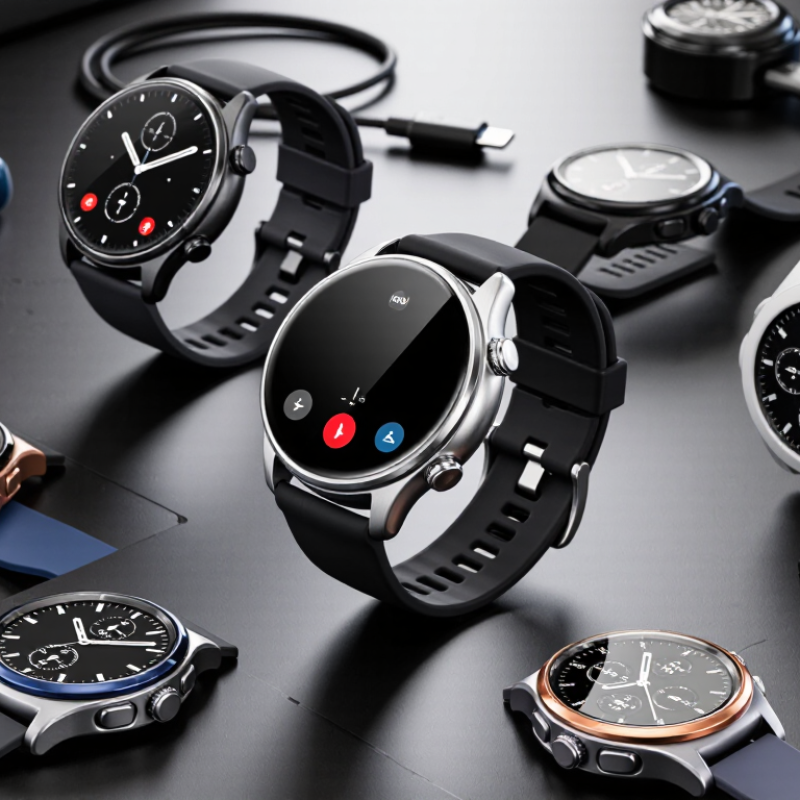
A Bluetooth calling smartwatch is more than a wrist display that mirrors phone alerts. It uses a short-range wireless connection to support calls through a built-in microphone and speaker. Some models also include a dial pad, contact list, or call history. Small parts matter: a speaker opening can sound clear indoors yet become difficult to hear beside traffic.
Bluetooth profiles describe how devices exchange specific types of information. A hands-free profile commonly supports call audio and call control, while other profiles may handle notifications or data. Exact support varies by watch and phone. Check compatibility rather than assuming every Bluetooth connection enables calling. A paired device may still lack the required call functions.
Connectivity depends on distance, obstacles, and the phone’s Bluetooth settings. Walls, crowded wireless environments, and a phone left in another room can interrupt audio. Battery use may also rise during longer calls. Microphone placement and noise reduction affect how well the other person hears you. Test calls in a quiet room and outdoors. Results can differ. That is worth noting. For buyers comparing suppliers, request clear specifications for supported profiles, phone compatibility, microphone performance, and typical call battery life. Published figures are useful, but real-world performance can be uneven.
Bluetooth SIG’s market forecast projects 7.3 billion Bluetooth device shipments annually by 2028. That figure strengthens China’s position in connected wearable manufacturing. Suppliers now develop watches with microphones, speakers, health sensors, and compact antennas.
A calling smartwatch is not merely a smaller phone. It must manage voice clarity, connection stability, heat, and battery drain inside a thin case.
Industry reports add useful context. The International Data Corporation tracks steady growth in wearable device shipments, while Counterpoint Research identifies smartwatches as a major wearable segment. These reports suggest continuing demand, but forecasts are not guarantees. Purchasing teams should verify factory capacity, component traceability, and software update procedures before placing large orders. The sample should survive repeated calls, sweat exposure, charging cycles, and crowded wireless environments.
Testing experience often reveals practical weaknesses. A watch may sound clear in a quiet office, yet fail beside machinery or a busy road. Suppliers should provide Bluetooth qualification evidence, radio test records, battery safety documentation, and measured standby results. Ask for production-line inspection data. Small details matter.
A reliable supplier also explains its limits. Some factories depend heavily on external design houses, which can slow troubleshooting. Others offer attractive pricing but incomplete validation records. That trade-off deserves scrutiny. Buyers should compare engineering support, tooling control, firmware ownership, and after-sales responsiveness—not only the unit quotation.
China’s calling smartwatch market demands more than attractive samples. The Bluetooth SIG 2024 Market Update projects billions of Bluetooth device shipments annually through 2028, increasing pressure on reliable voice performance. IDC’s Worldwide Quarterly Wearable Device Tracker reported 537.2 million wearable shipments in 2024. Suppliers should show proven OEM capacity, not only factory photos. Check whether they manage EVT, DVT, and PVT stages, firmware customization, tooling, and stable component sourcing. Request call samples from three production batches. A polished demo can still hide inconsistent microphones.
Certification evidence must match the destination market and exact model. Ask for current test reports covering radio performance, electromagnetic compatibility, battery safety, and material restrictions. Depending on the market, documents may include CE, FCC, UKCA, RoHS, REACH, and UN38.3 transport testing. Verify the laboratory’s accreditation and report number. Do not accept a logo printed on a quotation. For quality control, inspect incoming components, waterproofing seals, charging contacts, display pixels, battery capacity, and call latency. ISO 2859-1 sampling plans can support defined AQL inspections, but they do not replace full functional testing.
Tips: Ask for a process flow, defect history, and corrective-action records. Test calling beside machinery, outdoors, and in weak-signal areas. Review ten returned units, not only ten successful units. Suppliers should provide traceable serial numbers and firmware revision records. One overlooked weakness is after-sales engineering; response time matters when a microphone failure appears after launch. Use a paid pilot order before committing to volume.
This is a supplier-evaluation framework, not a verified ranking. No supplier-specific capabilities or certifications are claimed; verify each item against current documents, product samples, and independent test evidence.
| No. | Evaluation Dimension | What to Check | Evidence to Request or Verify | Suggested Weight |
|---|---|---|---|---|
| 1 | OEM and ODM capability | Confirm whether the supplier can manufacture to your specification, customize hardware or software, and support packaging and firmware changes. | Factory audit, product-development workflow, sample history, tooling ownership terms, and a written responsibility matrix. | 15% |
| 2 | Bluetooth calling performance | Test call connection stability, microphone pickup, speaker clarity, reconnection behavior, and compatibility with the intended phone operating systems. | Production-equivalent samples, test protocol, supported Bluetooth feature list, and documented results across representative phone models. | 12% |
| 3 | Bluetooth qualification | Check whether the product design and Bluetooth implementation have completed the applicable Bluetooth SIG qualification process. Qualification status should match the product being offered. | Qualification records and product identifiers that can be checked in the Bluetooth SIG database. Do not rely solely on a supplier-created logo or certificate image. | 10% |
| 4 | Radio and market-access compliance | Identify the destination markets and applicable radio requirements. For the EU, the manufacturer is responsible for conformity under applicable rules, including the Radio Equipment Directive where relevant; CE marking is not, by itself, proof of independent certification. | Declaration of Conformity, applicable radio test reports, model and antenna details, and evidence that reports cover the offered configuration. | 10% |
| 5 | Battery safety and transport | Verify battery specifications and safety evidence for the exact cell or pack. Lithium batteries offered for transport are subject to applicable UN Manual of Tests and Criteria, subsection 38.3 requirements. | Battery test reports and traceable model details; request a UN 38.3 test summary for the battery type being shipped, where applicable. | 10% |
| 6 | Quality management system | Assess documented controls for incoming materials, production inspection, nonconforming products, corrective actions, and traceability. A management-system certificate does not establish that a specific watch meets product requirements. | Current ISO 9001 certificate, scope and issuing-body details, audit findings or corrective-action records, and factory process documentation. | 10% |
| 7 | Production capacity and lead time | Confirm available production lines, realistic monthly output, seasonal capacity, component constraints, and the supplier’s ability to meet the requested schedule. | Capacity plan, production schedule, sample-to-mass-production timeline, and a written lead-time estimate tied to order quantity and configuration. | 10% |
| 8 | Reliability and quality controls | Review the supplier’s inspection plan and validation coverage for functions such as charging, display, buttons, audio, connectivity, and wear-related durability. | Incoming, in-process, and final inspection criteria; reliability-test methods and results; defect classification; and batch traceability records. | 10% |
| 9 | Software, app, and data handling | Check app maintenance, supported phone versions, update procedures, language support, data permissions, and the supplier’s process for addressing software defects. | Live app demonstration, software support policy, release history, privacy documentation, and a written plan for issue reporting and updates. | 7% |
| 10 | Commercial terms and after-sales support | Compare minimum order quantity, payment terms, warranty coverage, spare-parts availability, packaging requirements, and response times for quality claims. | Formal quotation, warranty terms, sample and tooling charges, claims procedure, service contact, and agreed acceptance criteria. | 6% |
China’s top Bluetooth smartwatch suppliers now compete on calling quality, endurance, compatibility, and factory pricing. IDC reported that global wearable shipments reached about 611.5 million units in 2024, showing strong demand for practical connected devices. For buyers, calling is more than a microphone icon. Check dual-microphone noise reduction, speaker volume, contact synchronization, and whether calls work independently or only through a paired phone.
Battery claims need careful testing. Many supplier samples advertise five to seven days of typical use, but frequent Bluetooth calls can reduce runtime to one or two days. Counterpoint Research has reported continued growth in smartwatch adoption, yet real-world endurance still varies with screen brightness, GPS use, and call frequency. Ask suppliers for test conditions, charging time, battery capacity, and cycle-life data. Some claims seem optimistic. That deserves scrutiny.
Compatibility also affects total value. Confirm support for recent Android and iOS versions, Bluetooth profiles, notification languages, and the companion application’s update history. Entry-level factory quotations commonly fall near 18 to 35 US dollars, while models with cellular support, stronger materials, or advanced health sensors may exceed 50 dollars, depending on order quantity and certification requirements. A low quote can hide mold fees, packaging charges, or limited after-sales support. Compare landed cost, not only unit price. Trial orders remain essential, because one sample may perform well while later batches reveal microphone noise or unstable software.
Sourcing Bluetooth smartwatches with calling features requires more than comparing factory prices. A reliable supplier should provide Bluetooth qualification records, test reports, and a clear product configuration list. Confirm the exact radio module, firmware version, antenna design, and calling functions before placing samples. A qualified design can still fail after a component change.
Ask suppliers to share laboratory reports for radio performance, electromagnetic compatibility, electrical safety, battery safety, and charger testing. Check the laboratory’s accreditation and report dates. During a sample review, test pairing distance, microphone clarity, call stability, charging temperature, and battery runtime. Record results under repeatable conditions. Small details matter.
Export planning also needs product-specific research. Requirements may differ by destination, especially for radio equipment, batteries, chargers, labeling, manuals, and packaging. Request customs documentation, product specifications, test evidence, and transport information before production. For lithium batteries, confirm the required shipping documents and packaging controls with the carrier. Do not rely on verbal promises. A supplier may understand manufacturing well but still miss a market-specific filing. That risk is easy to underestimate.
An independent pre-shipment inspection can compare production units with approved samples. Inspect serial labels, accessories, firmware, and carton markings. Keep a written change-control process. It may feel excessive. It is not. Even experienced buyers can overlook a revised module or an incomplete report when schedules become tight.
It is a wrist device with a microphone and speaker for phone calls. It can also show alerts, contacts, and call history.
No. Pairing alone does not guarantee calling support. The watch and phone need compatible call profiles and settings.
It uses a short-range wireless connection. Distance, walls, and nearby devices can weaken the signal.
A phone in another room may cause problems. Thick walls, traffic, and crowded wireless areas can reduce call stability.
Sometimes. A quiet room may sound excellent, while traffic can cover your voice. Microphone placement and noise reduction matter.
Usually, yes. Longer calls use more power through the speaker, microphone, and wireless connection. Published battery figures may feel optimistic.
Request supported profiles, phone compatibility, microphone tests, battery results, and wireless qualification records. Ask for production inspection data, too.
Test repeated calls, sweat exposure, charging cycles, and crowded wireless conditions. Compare quiet-office results with busy-road performance.
No. Forecasts suggest demand, not guaranteed quality or capacity. Verify factory resources, component records, software support, and troubleshooting ability.
Low pricing may hide incomplete testing or weak support. External design dependence can slow repairs. That trade-off deserves a closer look.
China’s Bluetooth Smartwatch with Calling supplier market offers a wide range of manufacturing capabilities, from basic voice-call models to advanced devices with health tracking, notifications, GPS, and multi-device compatibility. This overview explains how Bluetooth profiles, wireless connectivity, and core functions influence product performance. It also highlights the market’s expected growth, with annual Bluetooth device shipments forecast to reach 7.3 billion by 2028, creating strong opportunities for global sourcing.
To identify reliable suppliers, buyers should assess OEM and ODM capacity, production scale, quality-control systems, and relevant certifications. Key comparison points include call clarity, microphone and speaker performance, battery endurance, operating-system compatibility, customization options, and total pricing. Before export, suppliers should complete Bluetooth qualification, product safety testing, radio-frequency evaluation, labeling checks, and destination-market compliance reviews. A structured sourcing process helps buyers reduce technical risks, maintain consistent quality, and select partners capable of delivering compliant products at competitive prices.

Dispatched from our UK warehouse with tracked shipping.
Every smartwatch and audio product is covered as standard.
One companion app across the whole product ecosystem.
Pairing, firmware and accessory help from our support team.
