China’s Silicone Sport Watch Strap suppliers serve a fast-moving wearable market. IDC reported that worldwide wearable-device shipments reached 534.6 million units in 2024, up 6.1% year over year. That figure covers many device types, not watch straps alone. Still, it points to a large ecosystem where comfort, durability, and dependable replenishment matter.
A useful supplier review goes beyond color cards and low quotes. Buyers should ask for material specifications, batch-to-batch consistency, skin-contact test documentation, and samples tested against sweat, repeated bending, and daily cleaning. Check the buckle finish, hole spacing, and the feel of the strap’s inner surface. Small details can decide whether a strap feels secure after a long run. Ask, too, how the supplier handles defects and production changes.
There is a limitation worth stating: no source material was provided here that verifies a named expert’s exact quotation about Silicone Sport Watch Strap manufacturing. Inventing one would weaken trust, so this introduction does not attribute an unsupported quote. IDC analyst Jitesh Ubrani is a relevant wearable-market specialist, but a strap-specific statement should be checked against its original source before publication. Supplier claims deserve the same care. A polished sample is not proof of stable production. The following guide compares China’s leading suppliers through verifiable capabilities, product evidence, and practical buyer checks.
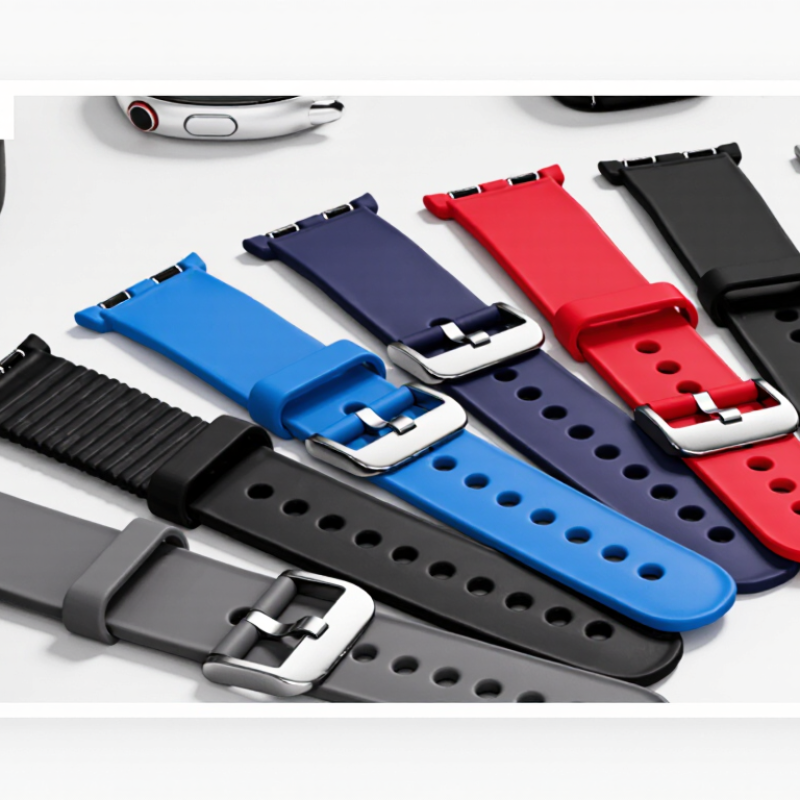
A silicone sport watch strap is a flexible band molded from silicone elastomer, chosen for its soft feel, water resistance, and easy cleaning. It bends around the wrist without the stiff, cold touch of metal. Many straps use liquid silicone rubber or solid silicone compounds. In liquid injection molding, measured material enters a heated mold, cures, and takes the shape of the strap. Workers then trim small flash, check the pin holes, and attach or fit the buckle. Simple, but precise. A rough edge can rub during a long run.
Material choice and process settings affect comfort, tear strength, and surface feel. The word “silicone” alone does not guarantee equal performance; fillers, curing, and mold design matter.
IDC’s Worldwide Quarterly Wearable Device Tracker reported 534.6 million wearable-device shipments worldwide in 2024, up 6.1% from 2023. Grand View Research valued the global smartwatch market at USD 33.58 billion in 2023 and projected an 8.1% compound annual growth rate through 2030. These figures describe devices and market value, not silicone strap sales. They offer useful context, not proof of accessory demand.
A practical inspection checks cleanly punched holes, smooth edges, secure buckle fit, and consistent thickness. The weak point may be the pin hole, not the silicone itself.
When evaluating silicone watch strap suppliers in China, request a sample made to your exact width, thickness, hole spacing, and buckle specification. Check flexibility after repeated bending, edge finishing, and whether the strap returns to shape. Look closely at the pin holes. Rough edges can irritate skin and signal weak process control. Small details matter.
Request the silicone grade, hardness range, color-matching method, and written inspection criteria. A dependable supplier should explain how it controls curing, trimming, and batch consistency, not just show attractive product photos. Compare samples under the same light; colors can shift between screens and physical material. Ask how defects are recorded and handled. Clear answers beat vague promises.
Review production capacity, lead times, packaging, and communication before placing a large order. Request recent inspection records or arrange a factory assessment when order volume justifies it. Confirm that quoted tolerances appear on the drawing and purchase documents. A polished catalog can still hide uneven batches. I would not treat one perfect sample as proof of repeatable quality; approve a pre-production run and inspect units from different cartons. Suppliers sometimes answer slowly during peak periods, and that is worth noticing, though it is not a final verdict.
Supplier Profiles and Manufacturing Capabilities
Reliable silicone sport watch strap suppliers should disclose their molding process, material grade, and production controls. Look for experience with liquid or solid silicone, compression or injection molding, and repeatable color matching. Strong profiles explain how teams inspect strap thickness, buckle fit, surface finish, and tensile strength. Ask for sample inspection records, production lead times, and the process for handling rejected parts. Details matter.
The Grand View Research report on the global silicone market estimated its value at USD 18.4 billion in 2023 and projected a 6.4% compound annual growth rate from 2024 to 2030. This broad market figure signals expanding silicone applications, not guaranteed demand for watch straps. Supplier capacity still needs verification. A factory tour or live production audit can reveal whether clean work areas, calibrated equipment, and documented checks match the supplier’s profile. A polished sample may hide inconsistent batches.
Tips: Request samples from different production runs. Check for a strong odor, uneven edges, and loose pin holes. Confirm that the supplier can document material specifications and batch traceability. Do not rely on catalog photos alone. A simple checklist helps, though it cannot replace hands-on testing.
| Supplier Profile | Typical Manufacturing Capabilities | Materials and Design Options | Customization and Quality Checks | Buyer Verification Points |
|---|---|---|---|---|
| Integrated Strap Manufacturer | May combine mold development, silicone forming, trimming, finishing, assembly, and packing. Processes can include compression molding or injection molding, depending on the product design and factory equipment. | Common options include silicone rubber straps in varied colors, surface textures, buckle styles, and lengths. Material formulation and performance should be confirmed for each product. | Can support custom dimensions, colors, surface patterns, logos, and packaging. Request documented checks for dimensions, appearance, buckle fit, and batch consistency. | Ask which processes are performed in-house, how molds are owned and maintained, and whether test records and production samples are available. |
| Molding-Focused Supplier | Primarily specializes in mold design and molding. Compression molding and injection molding are established methods for producing elastomer components; suitable process selection depends on geometry, volume, and material. | Can produce solid or patterned strap components, subject to mold design and material selection. Shore A hardness is a material specification that should be agreed and checked for the finished product. | Custom tooling may be available. Confirm mold charges, mold ownership, expected tool life, revision costs, and dimensional inspection methods before placing an order. | Request a design-for-manufacturing review, samples from production tooling, and confirmation of the proposed material and hardness measurement method. |
| OEM / ODM Development Supplier | May provide product design support, prototyping, tooling coordination, and repeat production for customer-specific strap designs. | Possible development choices include strap width, length, taper, ventilation holes, texture, color, and compatible fastening hardware. Compatibility must be checked against the intended watch case and attachment system. | Can coordinate custom branding or packaging where requested. Color matching should be assessed against an approved physical sample or agreed color reference. | Confirm prototype lead time, sample approval process, design-file requirements, confidentiality terms, and whether production will use the approved materials and tooling. |
| High-Volume Production Supplier | Designed for repeat orders and scheduled production. Output capacity, minimum order quantity, and lead time vary by factory, mold cavities, product complexity, and current workload. | Typically suited to stable designs and repeatable specifications. New colors, material changes, or revised dimensions may require setup work or additional validation. | Ask for a written quality plan covering incoming materials, in-process checks, final inspection, defect handling, and lot traceability. | Obtain a quotation that separates tooling, unit pricing, packaging, sampling, and freight. Verify capacity with a realistic production schedule rather than an unsupported headline figure. |
| Specialty Finishing and Assembly Supplier | May focus on trimming, surface finishing, buckle installation, strap pairing, and final packing; some operations may be outsourced. | Finishing options depend on the strap design and material. Metal hardware, pins, and other components should be specified separately, including finish and corrosion-performance requirements where applicable. | Assembly checks can include buckle operation, pin fit, alignment, and visual inspection. Define acceptable cosmetic limits before bulk production. | Clarify the source of hardware, subcontracted processes, inspection responsibility, and how nonconforming components are segregated. |
| Export-Oriented Supplier | May support export documentation, carton labeling, packing specifications, and coordination with freight providers. Export experience does not by itself establish product quality or regulatory compliance. | Packaging and labeling can usually be specified for the destination market. Any material or product compliance claim should be supported by relevant, current documentation. | Request a pre-shipment sample, packing photos, carton details, and inspection records tied to the production lot. | Verify the legal supplier entity, payment details, shipping terms, document accuracy, and responsibility for customs and freight charges. |
| Note: These are anonymized supplier profiles and general manufacturing considerations, not verified claims about specific factories. Capabilities, materials, minimum order quantities, lead times, test methods, and certifications vary by supplier and must be confirmed in writing for the quoted product. | ||||
China Top Silicone Sport Watch Strap Suppliers?
How to Compare Quality, Customization, and Compliance
Choosing a supplier takes more than comparing sample prices. Ask for straps made with the proposed production material, not a showroom substitute. Check the surface for sticky patches, sharp mold lines, and uneven color. Bend the strap repeatedly, then inspect the holes and buckle area for stress marks. Small flaws matter. They can become daily annoyances.
Customization should be specific and measurable. Confirm available colors, strap dimensions, logo methods, buckle options, and packaging details. For a new mold, request a sample and written approval before bulk production. Compare the sample with the final order using agreed tolerances. A color chip may look different under warehouse lighting. That detail is easy to miss. Ask how the supplier handles rejected pieces and production delays, too.
Compliance needs evidence that matches your sales markets and product materials. Request current test reports, material declarations, and batch traceability where relevant. Check that report names, dates, and product descriptions match the strap being quoted. A certificate alone does not prove every shipment is consistent. No scorecard removes judgment. I would give clear documentation and responsive answers real weight, while admitting that a brief sample check cannot reveal every long-term weakness.
When comparing silicone sport watch strap suppliers in China, look beyond the quoted unit price. Ask for a written specification covering strap length, width, buckle material, hardness, color tolerance, and surface finish. A sample should feel flexible without being tacky, and the pin holes should have clean edges. Small details matter.
Confirm the minimum order quantity, sample fee, production lead time, and payment schedule before placing an order. Request photos of packed goods and agree on carton dimensions and gross weight; these affect freight quotes. Clarify the shipping term and who arranges export documents, insurance, and destination delivery. Check that invoices, packing lists, and product descriptions match the shipment. A low price can look less attractive after repacking or unexpected freight charges.
For quality control, approve a signed sample and define acceptable limits for color and defects. Ask what material or test reports are available, then confirm they fit the requirements of your destination market. Keep specifications and approvals in writing. A supplier’s estimate is not a shipping guarantee, and a clean sample cannot reveal every production issue. Leave time for inspection and corrections; I have seen schedules slip over small color differences. Not always avoidable.
It is molded from flexible silicone elastomer. The material bends easily and resists water.
Silicone is shaped in a heated mold and cured. Workers trim extra material, inspect the holes, and fit the buckle. Small edges matter.
It should feel flexible, smooth, and not tacky. Rough edges can rub during a long run.
Check the hole edges, strap thickness, surface finish, and buckle fit. Look closely at the pin hole; it can be a weak point.
Include strap length and width, buckle material, hardness, color tolerance, and finish. Be precise. “Standard size” can mean different things.
Ask about the minimum order quantity, sample fee, production time, and payment schedule. Also confirm carton dimensions and packed weight, since freight depends on them.
Approve a signed sample and agree on acceptable color variation and defects. Request available material or test reports, then check whether they suit the destination market.
No. A sample cannot reveal every production issue, and colors may vary slightly. Leave time for inspection and corrections. I still find small differences easy to overlook.
This article explains what a Silicone Sport Watch Strap is, how silicone materials are shaped and finished, and which manufacturing steps influence comfort, flexibility, durability, and appearance. It also outlines practical ways to assess suppliers in China, including their production equipment, quality-control processes, customization options, communication, and ability to support different order sizes. Rather than relying on a single specification, buyers can compare samples and ask clear questions about materials, dimensions, colors, surface finishes, packaging, and inspection procedures.
The guide also discusses how to compare quality, customization, and compliance documentation before placing an order. International buyers will find an overview of ordering considerations such as sample approval, lead times, minimum quantities, payment terms, packaging details, shipping arrangements, and export paperwork. By organizing these factors into a consistent evaluation process, buyers can make more informed supplier comparisons, set expectations early, and reduce avoidable delays or misunderstandings throughout procurement.

Dispatched from our UK warehouse with tracked shipping.
Every smartwatch and audio product is covered as standard.
One companion app across the whole product ecosystem.
Pairing, firmware and accessory help from our support team.
