Choosing a Chinese manufacturer for a Touchscreen Fitness Tracker takes more than comparing product photos and unit prices. Buyers should examine screen responsiveness, battery performance, sensor consistency, app compatibility, and the quality of production controls. A bright display is easy to admire in a sample; reliable readings after weeks of daily wear are harder to judge.
Human-computer interaction expert Don Norman offers a useful design principle: “Good design is actually a lot harder to notice than poor design.” That idea matters here. A tracker should respond to a damp fingertip, remain readable under outdoor light, and make common tasks clear without endless tapping. These details sound small. They shape everyday trust.
This overview considers manufacturers in China through practical questions: What evidence supports their performance claims? Can they explain testing methods, customization limits, and after-sales support? Do their samples match their production units? Factory visits, independent testing, and clear written specifications can help answer those questions. Still, no shortlist can replace buyer-specific checks. A polished catalog may hide uneven quality, and a capable supplier may not suit every project. The comparison ahead is a starting point, not a guarantee.
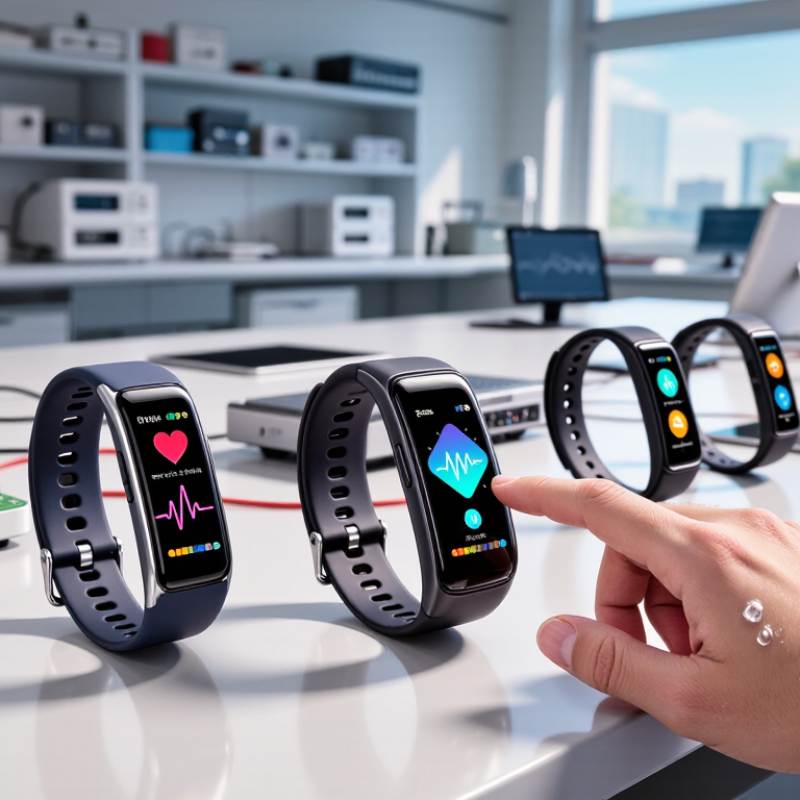
A touchscreen fitness tracker combines a wrist-worn display with sensors that estimate activity and basic wellness measures. The screen should remain readable outdoors, respond reliably to damp fingers, and show key data without excessive tapping. Small icons can look elegant in a product photo but become frustrating during a run. Comfort matters too: a heavy case or stiff strap may discourage all-day wear.
Common features include step counting, heart-rate tracking, sleep estimates, workout modes, and phone notifications. These readings are useful for spotting patterns, not diagnosing health conditions. Sensor results can vary with wrist fit, movement, skin contact, and device settings. Some readings will be noisy. That is worth remembering before treating a single number as precise. Battery life also depends on screen brightness, GPS use, and how often measurements are taken.
When assessing manufacturers in China, buyers can ask for clear sensor specifications, screen details, battery test conditions, and sample units for hands-on checks. Water resistance should be described with a stated rating and use limits, not vague claims. Review how the display performs under bright light and whether menus remain usable with one hand. More features are not always better; a cluttered interface can hide the data people actually need.
China’s touchscreen fitness tracker industry is organized around connected suppliers, not isolated factories. A device may draw its display, touch panel, sensors, battery, circuit board, and casing from different specialists. Many suppliers operate within manufacturing regions such as the Pearl River Delta and Yangtze River Delta, which can shorten coordination and delivery times.
The structure is layered. Product developers define features and industrial design, while OEM and ODM manufacturers handle engineering, tooling, assembly, and production testing. Some suppliers build complete trackers; others focus on components or specific processes. That division can help a buyer scale an order, but it also makes clear communication essential. A small change to screen size or strap tooling may affect several suppliers.
Quality work happens across the chain. Teams can test touch response with damp fingers, check sensor readings against reference equipment, and inspect battery performance and water resistance. Details matter. Buyers should review sample units, production controls, and traceability records before committing to volume. Capability claims are not always easy to compare, and published information may leave gaps. Even a polished sample can hide production variation, so repeated checks are worth the extra time.
China’s role in global manufacturing provides context for its fitness-tracker supply chain; this figure is not a tracker market share or a manufacturer ranking.
The industry is organized across component suppliers, contract manufacturers, assembly and testing facilities, and export channels. UNIDO reports China contributed approximately 31% of global manufacturing value added in 2022; that broad measure does not isolate fitness trackers.
Source: UNIDO, International Yearbook of Industrial Statistics 2023. Figure shown as an approximate share.
China’s leading touchscreen fitness tracker manufacturers combine product engineering with high-volume electronics production. Many offer OEM and ODM services, covering enclosure design, display integration, firmware, and packaging. When assessing a supplier, ask for a working sample and check touch response with damp fingers, outdoor readability, and battery life during continuous heart-rate tracking. A bright screen can look impressive indoors, yet drain power quickly during daily use.
Market growth supports continued investment. IDC reported that worldwide wearable-device shipments reached 538.9 million units in 2024, up 6.1% year over year in its Worldwide Quarterly Wearable Device Tracker. This figure covers wearables broadly, not touchscreen fitness trackers alone. It signals demand, but does not prove that every factory has strong quality controls. Request recent test records, production capacity, component specifications, and a clear process for handling defects. Small details matter: a loose charging contact can undermine an otherwise polished device.
Tips: Compare sample units under the same conditions. Confirm screen size, water-resistance test methods, app compatibility, and firmware-update support in writing. Factory claims can be imperfect; verify them before placing a large order.
When evaluating Chinese fitness tracker manufacturers, look beyond product photos and quoted prices. Ask whether the factory handles assembly, testing, or both. A clear answer helps you understand who controls quality. Request sample units and inspect touchscreen response with dry and slightly damp fingers. Check brightness outdoors, menu readability, and whether swipes register consistently.
Ask for documented checks on heart-rate sensor performance, battery life, charging, and water resistance. Request test reports, and confirm what each report covers; a certificate alone may not describe your exact model. Review firmware update procedures, defect handling, production lead times, and the process for approving design changes. A polished sample can still hide production differences. Test units from a pilot run, not just the hand-picked sample. This takes time, but skipping it can be costly.
Tips: Use the same test checklist for every supplier. Record screen response, step-count variation, and battery drain over several days. Ask for written answers and dated reports. If a factory cannot explain a failed test clearly, pause and investigate. Some details will remain uncertain; note them rather than assuming the best.
Choosing a touchscreen fitness tracker manufacturer in China requires more than comparing unit prices. Review its production flow, component sourcing, and engineering support. Ask how it manages display bonding, touch sensitivity, battery integration, and enclosure sealing. Request a pilot run before approving larger quantities. Inspect several units, not just the best sample. A polished sample can still hide weak production controls. Details matter.
Tips: Provide a written specification covering screen size, sensor functions, materials, and packaging. Agree on measurable checks, such as touch response across the display and charging performance after repeated use. Ask for inspection records and clear procedures for handling defects. Test in context.
Customization can affect cost, timelines, and reliability. Confirm which components can change without redesigning the whole device. Check how firmware updates and interface adjustments are reviewed before release. Quality assurance should include incoming-part checks, in-process inspections, and final testing under documented criteria. If possible, observe a production run or have an independent inspector examine samples. One limitation is easy to overlook: a short test cannot predict every failure after months of daily wear. Set expectations accordingly, and keep room for revisions after user testing.
Use this comparison framework to evaluate China-based OEM/ODM suppliers. It focuses on verifiable capabilities rather than naming or ranking companies; actual specifications and compliance status should be confirmed for each model and production site.
| Evaluation Dimension | What a Capable Supplier May Offer | What to Verify Before Ordering | Relevant Evidence or Test |
|---|---|---|---|
| Touchscreen and Display | Integration of a capacitive touch panel with an LCD or OLED display, with screen size, resolution, brightness, and interface options selected for the product design. | Request a working sample and confirm readability, touch response, viewing angle, outdoor visibility, and performance with the intended firmware. | Sample inspection; display and touch-function test; review of the approved product specification. |
| Product Design and Customization | OEM/ODM services may cover enclosure design, colors, straps, user interface, firmware, packaging, and integration of available sensors. | Clarify which features are standard and which require new engineering. Confirm tooling ownership, design-change approval, sample rounds, and minimum order quantities in writing. | Approved drawings, bill of materials, golden sample, change-control records, and a written project schedule. |
| Sensor and Fitness Functions | Depending on the model, a tracker may include motion sensors, optical heart-rate sensing, sleep tracking, workout modes, or other wellness functions. | Check the exact sensor components, supported functions, measurement limitations, and consistency across devices. Do not assume that a consumer tracker provides medical-grade measurements. | Functional testing against defined acceptance criteria; documented firmware version and test results. |
| Battery and Charging | Rechargeable lithium batteries and model-specific charging solutions are common design choices for wearable devices. | Confirm battery capacity, charging time, expected operating conditions, protection features, and the battery supplier used in the production build. | Battery specification and applicable test documentation. IEC 62133-2 covers safety requirements and tests for portable sealed secondary lithium cells and batteries. |
| Water and Sweat Resistance | Some models are designed for resistance to sweat or water exposure; protection levels differ by enclosure, seals, buttons, and charging design. | Verify the exact rated level for the finished model and intended use. A rating should not be inferred from appearance or from a component-level test. | Request a test report for the finished product. IEC 60529 defines IP Code enclosure protection classifications; the stated rating and test conditions matter. |
| Bluetooth and App Compatibility | Wireless connectivity and companion-app integration can be provided, subject to the product’s radio design, firmware, and supported mobile platforms. | Test pairing, reconnection, notifications, data synchronization, and supported operating-system versions. Confirm responsibility for app maintenance and updates. | Connectivity test records and applicable Bluetooth qualification/listing information for the product design. |
| Production and Process Control | A supplier may manage assembly, inspection, and functional testing in-house or through qualified subcontractors. | Identify the actual manufacturing site and subcontracted processes. Review production flow, traceability, defect handling, and controls for component substitutions. | Site audit, process flow, lot records, incoming and in-process inspection records, and corrective-action documentation. |
| Quality Management | A documented quality-management system can support repeatable production and controlled handling of defects and changes. | Check the certificate issuer, validity, covered site, and scope. Certification alone does not establish that a specific tracker meets its product requirements. | For an ISO 9001 claim, verify the current certificate and confirm that its scope and site are relevant to the work being ordered. |
| Regulatory and Market Requirements | Compliance needs depend on destination market, radio functions, battery configuration, materials, and product claims. | Define target markets before production and confirm that reports apply to the final model, bill of materials, and radio configuration. | Review applicable market documentation. RoHS restricts specified hazardous substances in covered electrical and electronic equipment; applicability and exemptions should be checked for the product. |
| Battery Transport Documentation | Suppliers shipping products with lithium batteries should be able to provide applicable battery transport documents for the shipped configuration. | Match the documents to the battery type, model, and shipment configuration; confirm current carrier and destination requirements. | UN Manual of Tests and Criteria, subsection 38.3, sets out tests for lithium cells and batteries transported by air, sea, road, or rail. |
| Final Inspection and Shipment | Pre-shipment checks can include appearance, accessories, charging, screen operation, buttons, and packaging verification. | Agree on measurable acceptance criteria, inspection sampling, defect classifications, packaging specifications, and the process for handling rejected lots. | Signed inspection checklist, approved packaging sample, lot identification, and pre-shipment inspection report. |
Supplier selection tip: compare like-for-like samples and specifications, then verify certificates and test reports independently where practical. No single certification or test report guarantees the overall quality of every production unit.
Test touch response with damp fingers, outdoor readability, and battery life during continuous heart-rate tracking. Compare units under matching conditions.
A pilot run can reveal differences between a polished sample and regular production units. Inspect several devices, not just one.
Ask about display bonding, battery integration, enclosure sealing, component sourcing, and production capacity. Small parts matter.
Include screen size, sensor functions, materials, packaging, app compatibility, and firmware-update support. Clear details reduce guesswork.
Agree on checks for touch response across the display and charging after repeated use. Request inspection records and defect-handling procedures.
Confirm which components can change without requiring a full redesign. Discuss costs, timelines, firmware updates, and interface reviews.
Not fully. A brief test may miss failures that appear after months of daily wear, so leave room for revisions after user testing.
It signals broader demand, but does not confirm any factory’s quality controls. Verify recent test records and production processes.
This article explains what a Touchscreen Fitness Tracker is and how features such as display responsiveness, health and activity monitoring, battery life, connectivity, and comfort shape the user experience. It also outlines how China’s fitness tracker manufacturing industry is organized, from product design and component sourcing to assembly and testing. Rather than focusing on brand names, the article describes the types of manufacturers and suppliers involved and how their roles may differ.
Readers will learn how to evaluate potential Chinese manufacturing partners by reviewing technical capabilities, communication, production capacity, and experience with similar products. The article also covers customization options, including display design, software features, materials, and packaging, while emphasizing quality assurance throughout development and production. Careful assessment of samples, testing procedures, and production consistency can help buyers make informed decisions and select a manufacturer whose capabilities align with their product goals.

Dispatched from our UK warehouse with tracked shipping.
Every smartwatch and audio product is covered as standard.
One companion app across the whole product ecosystem.
Pairing, firmware and accessory help from our support team.
